 INDEX
INDEX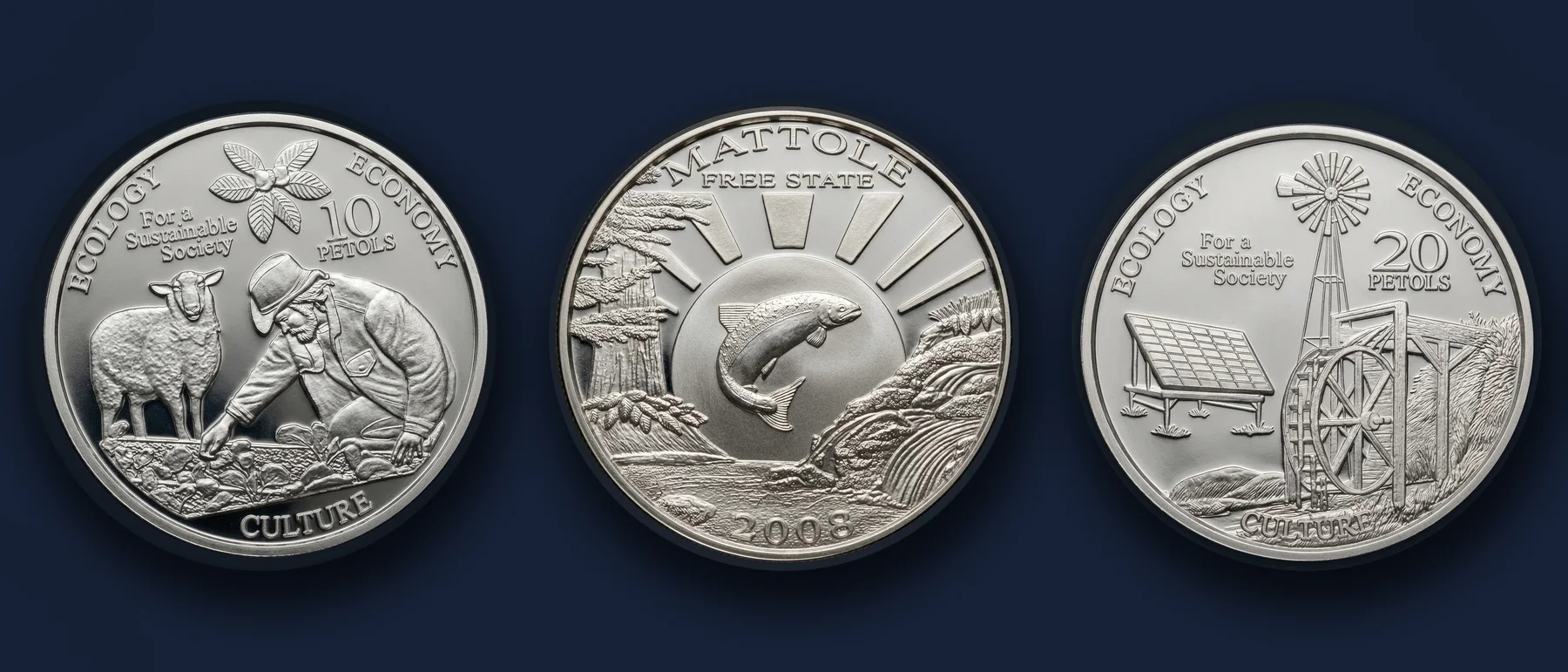
Tucked into Northern California's rugged Emerald Triangle, the remote Mattole Valley has long attracted people drawn to independence, self-sufficiency, and unconventional ways of life. Before cannabis legalization, the region was particularly well known for its underground marijuana economy.
Against that backdrop, Petrolia resident Ken Young set out to create something equally unconventional: a local currency made from precious metal. He called it the Petol, after his hometown.
Young's monetary experiment may have ended, but the coins survived.
Why silver
Young believed the American monetary system had become dangerously out of balance. For him, sound money was part of a larger vision for a sustainable community, one where culture, economy, and ecology existed in balance.
He saw two turning points: the creation of the Federal Reserve in 1913, and the eventual disappearance of silver from circulating U.S. coinage. In his view the dollar had stopped being a true store of value. It had become only a medium of exchange, fiat money whose acceptance rested on government authority rather than precious-metal content.
A debt-based system and fractional-reserve banking, he argued, steadily eroded the dollar's purchasing power. A silver-based local currency could help insulate the valley from inflation or a larger crisis, and strengthen its self-sufficiency.
Local currencies were hardly new, but Young saw a weakness in most of them. They were paper, useful mainly among the people who agreed to accept them. The Petol would be different. Its silver gave it intrinsic value independent of local acceptance, so even outside the Mattole Valley the metal kept its worth.
The first Petols
Young introduced the first issue in 2007. The 10 Petols coin held one troy ounce of silver and carried imagery for three parts of sustainable food production: ranching, gardening, and gathering.
He paid for the project himself, commissioning 2,000 pieces from Northwest Territorial Mint. The 2007 issue is the only known year in which the 10 Petols denomination was struck.
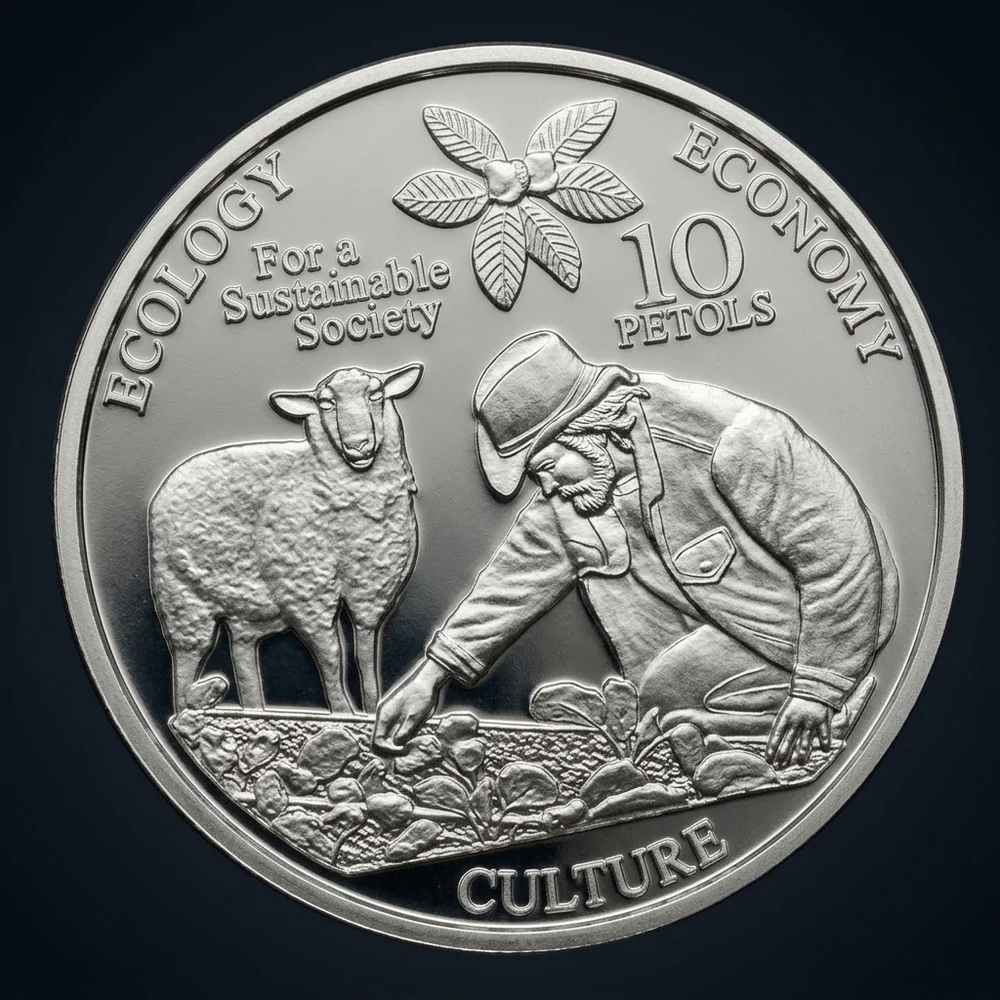 The 10 Petols (2007). Ecology, Economy, and Culture frame a gardener and his sheep.
The 2008 series
The next year Young widened the series. The 2008 issues added silver coins of 1, 2, 5, and 20 Petols, struck in .999 fine silver, plus a brass ½ Petol. Each design reflected the culture and ideals of the valley.
| Denomination | Silver | Design |
|---|---|---|
| ½ Petol (brass) | None | A female fiddler and a male guitarist |
| 1 Petol | 0.1 oz | Two plants, including cannabis |
| 2 Petols | 0.2 oz | Horse-drawn wagon and tandem bicycle |
| 5 Petols | 0.5 oz | A woman weaving at a loom, with a spinning wheel |
| 10 Petols (2007 only) | 1 oz | Ranching, gardening, and gathering |
| 20 Petols | 2 oz | Waterwheel, windmill, and solar panel |
The 20 Petols is the largest of the set, and its symbols of alternative and renewable energy make it the most direct statement of Young's politics.
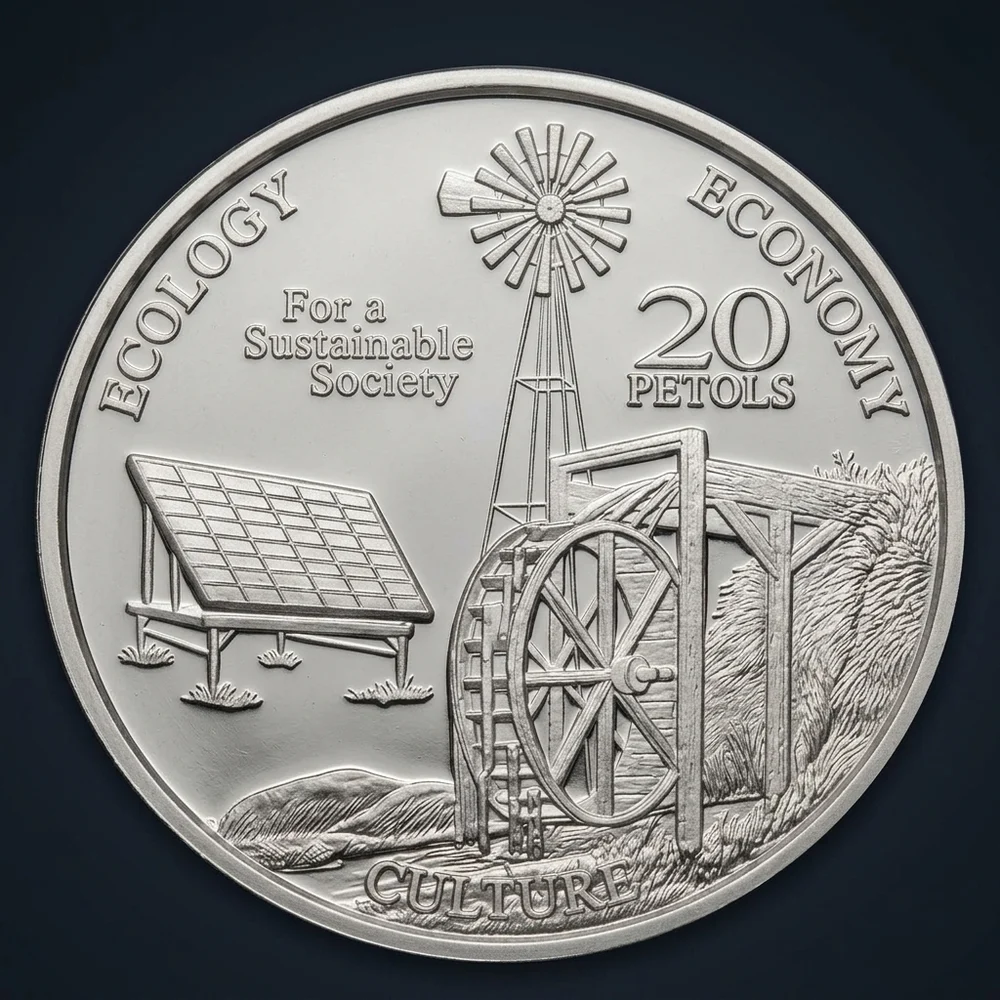 The 20 Petols (2008), two ounces of silver.
Taken together, the designs show more than a monetary system. They show Young's picture of a self-reliant community built on agriculture, craftsmanship, transportation, renewable energy, and local culture.
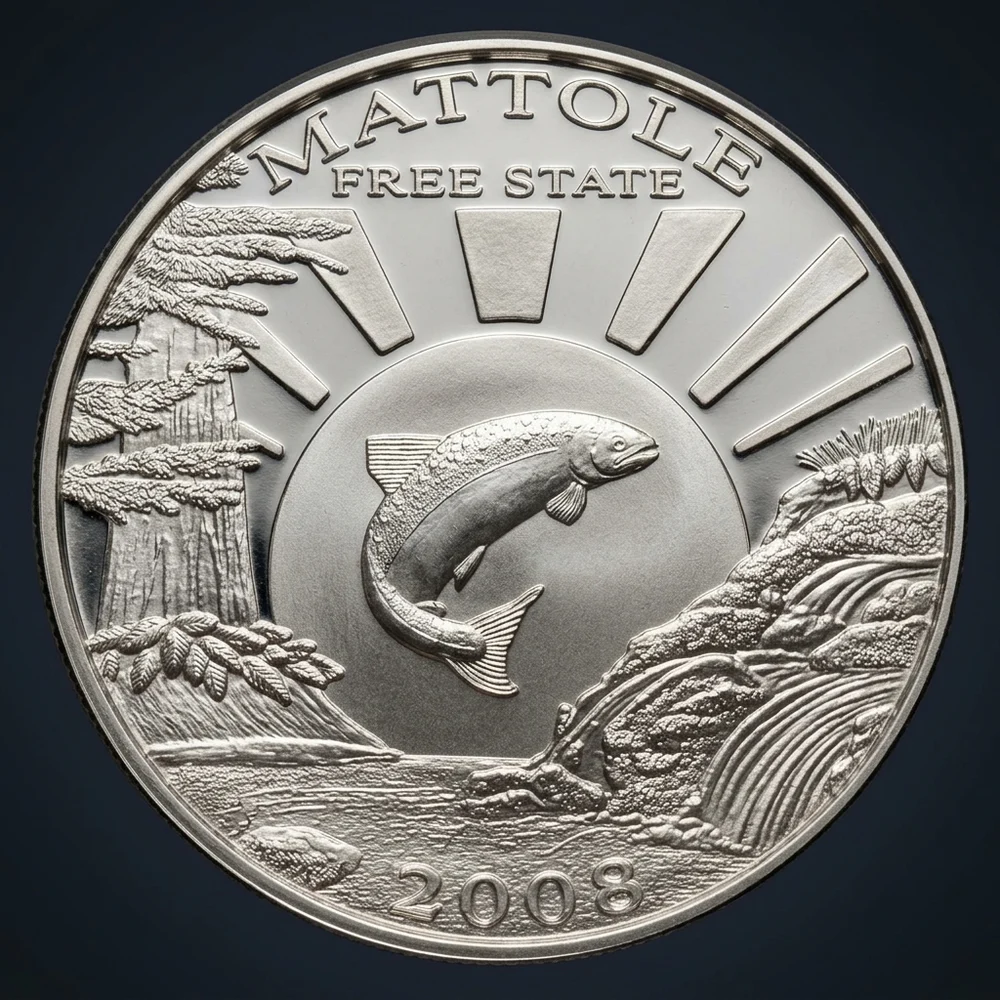 The Mattole Free State side, dated 2008: a salmon leaps in front of a rising sun between a redwood and a waterfall.
Tilting the 10 Petols in the light.
A bank for the valley
Young pictured Petols passing across counters throughout the valley as payment for everyday goods and services. His plans went past the coins. He also proposed a Mattole River Bank that would lend to year-round residents starting sustainable businesses that served the community. He considered biodiesel production and an electric power cooperative suitable candidates for loans.
It was an ambitious vision, but doing business in dollars proved hard to overcome. The local store declined to accept Petols because of the complications of converting them. Young kept offering his coins at the local farmers market, introducing residents and visitors to his experiment in precious-metal money.
How many survive?
Nobody knows exactly how many Petols were made. Northwest Territorial Mint is out of business, and no complete official mintage records for the series are known.
Contemporary reporting gives a few clues. One news account said Young sold about 400 Petols in the first few months. Since the 10 Petols was struck only in 2007, the 2,000 pieces he financed appear to be the maximum mintage for that issue.
Third-party grading populations point the same way. Only a small number of graded examples turn up across the denominations. Those figures are not mintage totals, but they show how seldom certified Petols appear in the market.
Ken Young's legacy
Ken Young died on February 3, 2018, at age 76. His dream of a widely circulating Mattole Valley silver currency never grew to the scale he imagined. Yet the Petol remains a tangible artifact at an unusual crossing of American numismatics, alternative economics, environmentalism, and the culture of Northern California's Emerald Triangle.
What began as one man's attempt to create real money for his community has, with time, become something else: a little-known chapter in modern American numismatic history.
Today, the Petol tells his story.