 INDEX
INDEX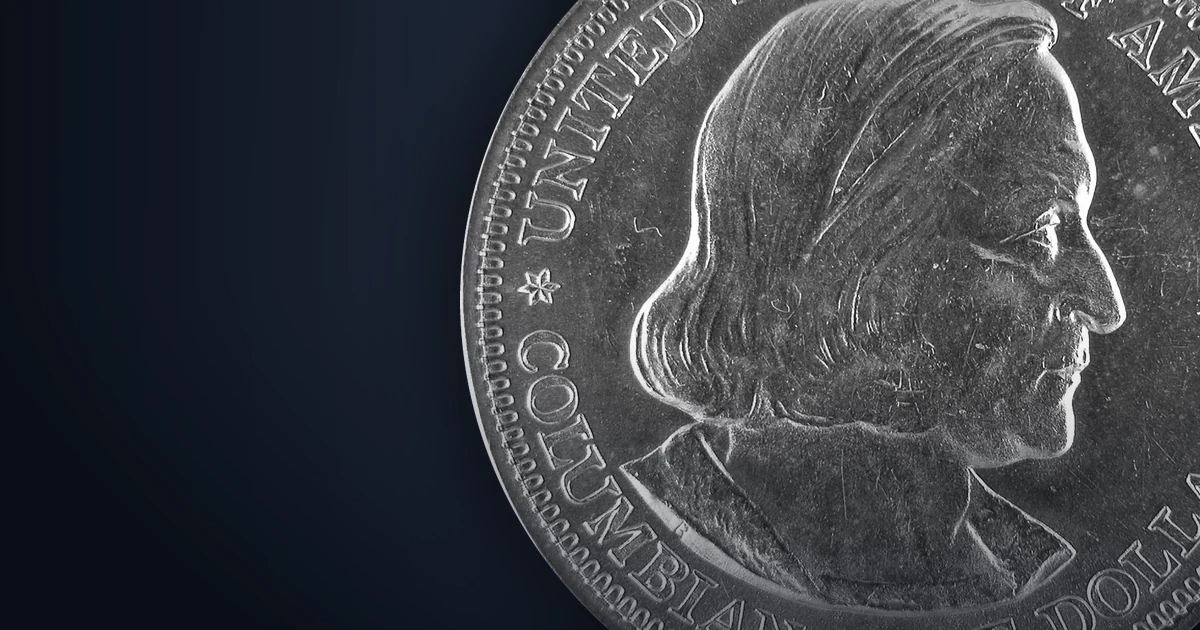
The Columbian half dollar: America's first commemorative coin
Listen: The 1893 Columbian half dollar disaster
22:03The Columbian half dollar: America's first commemorative coin
In the summer of 1892, the United States Senate spent an afternoon arguing about whether the government should be in the souvenir business.
The occasion was the World's Columbian Exposition, the vast Chicago world's fair meant to mark four hundred years since Columbus reached the Americas. The fair needed money. Congress did not want to simply hand it over. So somebody proposed a clever workaround: mint a special half dollar, give the coins to the exposition at face value, and let the exposition sell them to the public for a dollar apiece. Every coin sold would net the fair fifty cents, and the government would not have written a check at all.
Senator William B. Allison of Iowa liked it. The coins were ordinary redeemable silver, he argued, and the public would want them as keepsakes. Senator John Sherman of Ohio did not. If the government intended to issue ordinary money anyway, he said, it should just appropriate the cash and skip the theater. And if it issued five million of them, the souvenir premium would drown in its own supply.
Sherman was right. It took about a year to prove it.
What Congress actually authorized
The Act of August 5, 1892 authorized silver half dollars "not to exceed five million pieces," to be struck from "uncurrent subsidiary silver coins now in the Treasury." Worn coin in, souvenir coin out. The pieces would be paid to the exposition against certified vouchers for labor, materials, and services, and every ordinary law governing subsidiary silver, legal tender status, and redemption applied to them.
That last detail is the one that mattered, and almost nobody noticed at the time. Congress did not create a medal or a token. It created a legal tender half dollar and then asked the public to pay two dollars' worth of enthusiasm for one dollar's worth of silver.
The statute carried the fingerprints of a larger political fight. Payment was conditioned on proof that the exposition had already collected and disbursed ten million dollars. And Congress attached a proviso that acceptance of federal money required the fair to close on Sundays, a religious concession that had nothing to do with coinage and everything to do with who controlled the exposition. The half dollar was never a stand-alone numismatic gesture. It was one clause in a much bigger bargain.
A design with three names on it
The Mint credits Charles E. Barber with the obverse and George T. Morgan with the reverse. Numismatic literature has always told a fuller story, tracing both back to plaster models by the sculptor Olin Levi Warner. The most honest reading is that the coin was collaborative: Warner supplied the artistic conception, and the Mint's two most experienced engravers translated it into something a coining press could actually strike a few million times.
The obverse carries a right-facing bust of Columbus. The reverse carries his flagship, the Santa Maria, sailing above two hemispheres, with the anniversary date 1492 below and the striking year at the bottom.
There is a quiet problem behind that portrait. No verified likeness of Columbus painted during his lifetime is known to exist. The face on the coin is not a portrait in any documentary sense. It is a late nineteenth century idea of what a discoverer should look like, which is arguably more revealing than an accurate one would have been.
The rest of the design shows the Mint winning its arguments. The law required a coin, not an art medal, and the Director of the Mint held formal design authority. So the inscriptions are broad and legible, the relief is restrained, and the ship is detailed enough to read as history without compromising how the pieces stack in a bag. Before the coin ever failed as a souvenir, its design language had already conceded that it might have to work as money.
Two dates, and far fewer coins than Congress allowed
All Columbian halves were struck at Philadelphia and carry no mint mark. They are standard silver half dollars of the period: ninety percent silver, 30.6 millimeters, 12.5 grams, reeded edge.
The recoinage ran from early December 1892 to the end of March 1893, consuming worn subsidiary silver that the Treasury was glad to be rid of. The output split across two dates: 950,000 pieces dated 1892 and 1,550,405 dated 1893, for a total of 2,500,405 coins.
That number is worth sitting with. Congress authorized five million. The Mint produced almost exactly half that. The shortfall was not a production problem. It was a demand problem, and it showed up fast.
A small number of proofs were also struck. Exactly how many has never been settled cleanly in the documentary record, and sources still disagree. What is not in dispute is that they are among the rarest pieces in the entire classic commemorative series.
The sales pitch, and what happened to it
The exposition did not rely on fairground sales. In February 1893 the press reported that the directors had invited merchants "throughout the Nation" to work with banks in placing Columbian half dollars on sale, specifically so that "the masses of the people" could buy them at a dollar each. This was a national retail campaign for a coin.
The Treasury's own annual report for 1893 delivered the verdict in one flat sentence: "Contrary to expectation, neither of the souvenir coins proved popular." At the close of the fiscal year the department was still holding $1,820,880 in Columbian halves, some never collected and some returned for redemption.
By September 1893, newspapers reported that banks holding coins pledged by the fair management had found them unprofitable and were shipping them back to the subtreasury. The exposition's own auditor's report, dated January 31, 1894, carried separate ledger lines for "Souvenir coins" and "Premium on souvenir coins," which tells you plainly how the organizers thought about the object: not as a memento with a price, but as a financing instrument with a spread.
Then the spread closed. In fiscal 1894 the exposition management declined to pay the cost of recoining the halves that had drifted back into the Treasury. The government responded by offering the returned coins to the public at par, in exchange for gold or gold certificates, and a considerable sum went out that way.
That is the hinge of the whole story. The moment the federal government itself sold the coin for fifty cents, the dollar price became fiction. A commemorative that can be redeemed at face value is only worth more than face value for as long as the sentiment holds. The sentiment did not hold.
Common, and not
The afterlife is where the Columbian gets genuinely interesting for collectors, because it went two directions at once.
Because so many pieces eventually entered ordinary commerce rather than sitting in drawers, the coin is abundant. It is one of the easiest classic commemoratives to acquire in circulated grades, and it has been cheap for most of the past century. GreatCollections alone reports selling roughly 890 examples of the 1892 and about 1,185 of the 1893 over sixteen years, with prices starting around eight dollars. Those are enormous archive counts for a nineteenth century commemorative.
At the top of the grading scale the picture inverts. PCGS estimates around 300,000 surviving 1892 halves in all grades but only about 5,500 in MS65 or better. For the 1893, roughly 400,000 survive overall and only about 4,375 grade MS65 or finer. Prooflike and deep mirror prooflike examples form a smaller tier still, and PCGS recognizes repunched date varieties for both years. Auction records run past $35,000 for a top 1892 and past $20,000 for a top 1893.
The price history also carries a warning that has nothing to do with Columbus. Q. David Bowers documented that at the speculative peak around spring 1990, an MS65 1892 listed at $3,850 and an MS65 1893 at $5,000. By the 2019 edition of the Red Book, both were listed at $310. That collapse says nothing about the coin's historical importance and everything about what happens when a market runs ahead of the number of people who actually want the thing.
Why it still matters
The Mint counts the Columbian half dollar as the first commemorative coin it ever produced, and the classic series that followed ran from 1892 to 1954 across more than 180 silver and gold issues honoring 53 different subjects. Every one of them inherited the template this coin established: a hero, an occasion, a legible inscription, and a hope that the public would pay a premium.
It also established the cautionary half of the template. The Columbian tested commemorative coin finance in its very first outing and found the weak joint immediately. Congress liked the arrangement because it converted worn silver into a politically palatable subsidy. The Treasury liked it because it cleaned up the circulating stock. The exposition liked the fifty cent margin. All three were reasoning about the supply side, and none of them had a way to make two and a half million people want a souvenir at twice its face value in the middle of a year that would end in a financial panic.
For a collector today that history is oddly accessible. A worn Columbian half dollar costs very little and is a real object from the fair that introduced the Ferris wheel to America. A gem one is genuinely hard to find and priced accordingly. The coin is democratic and elite at the same time: easy to own, difficult to own beautifully, and impossible to leave out of the story of American commemorative coinage.
Mintages and melt value
90% Silver, 10% Copper. Melt values load with the live spot price.
| Date | Mint | Mintage | Face | ASW (oz) | Melt today |
|---|---|---|---|---|---|
| 1892 | Philadelphia | 950,000 | $0.50 | 0.3617 | — |
| 1893 | Philadelphia | 1,550,405 | $0.50 | 0.3617 | — |
| 1892-1893 proofs | Philadelphia | not settledsources disagree | $0.50 | 0.3617 | — |
Congress authorized up to five million pieces. Barely half that number was struck, which is the whole story of the coin in one line.
Metal content from the COINDEX coin taxonomy.